
Percentage Calculator
Calculate percentage from obtained marks and total marks.

This chapter belongs to a previous NCERT/CBSE curriculum and is not part of the current 2026-27 chapter list. Removed in 2022-23.
Welcome to the NCERT Solutions for Class 12 Chemistry - Chapter General Principles and Processes of Isolation of Elements. This page offers a step-by-step solution to the specific question from Exercise 2, Question 4:
Explain: (i) Zone refining (ii) Column chromatography.
. With detailed answers and explanations for each chapter, students can strengthen their understanding and prepare confidently for exams. Ideal for CBSE and other board students, this resource will simplify your study experience.Explain: (i) Zone refining (ii) Column chromatography.
(i) Zone refining: This method is based on the principle that impurities are more soluble in the molten state of metal than in the solid state. In the process of zone refining, a circular mobile heater is fixed at one end of a rod of impure metal. As the heater moves, the molten zone of the rod also moves with it. As a result, pure metal crystallizes out of the melt and the impurities pass onto the adjacent molten zone. This process is repeated several times, which leads to the segregation of impurities at one end of the rod. The end with the impurities is cut off. Silicon, boron, gallium, indium etc. can be purified by this process.

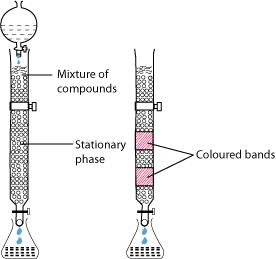
(ii) Column chromatography: Column chromatography is a technique used to separate different components of a mixture. It is a very useful technique used for the purification of elements available in minute quantities. It is also used to remove the impurities that are not very different in chemical properties from the element to be purified. Chromatography is based on the principle that different components of a mixture are differently adsorbed on an adsorbent. In chromatography, there are two phases: mobile phase and stationary phase. The stationary phase is immobile and immiscible. Al2O3 column is usually used as the stationary phase in column chromatography. The mobile phase may be a gas, liquid, or supercritical fluid in which the sample extract is dissolved. Then, the mobile phase is forced to move through the stationary phase. The component that is more strongly adsorbed on the column takes a longer time to travel through it than the component that is weakly adsorbed. The adsorbed components are then removed (eluted) using a suitable solvent (eluant).
The reaction between A and B is first order with respect to A and zero order with respect to B. Fill in the blanks in the following table:
| Experiment |
A/ mol L - 1 |
B/ mol L - 1 |
Initial rate/mol L - 1 min - 1 |
| I | 0.1 | 0.1 |
2.0 × 10 - 2 |
| II | -- | 0.2 |
4.0 × 10 - 2 |
| III | 0.4 | 0.4 | -- |
| IV | -- | 0.2 |
2.0 × 10 - 2 |
NCERT questions are designed to test your understanding of the concepts and theories discussed in the chapter. Here are some tips to help you answer NCERT questions effectively:
Stay updated with our latest educational content and study tips
All businesses are gathering information on customers, products, employees, and expenditures, and someone must make decisions based on the data. That individual is the data analyst. Unlike many career changers imagine, the job is open to a broader cross-section of the population than a typical career change. A lot of working analysts trained in commerce, … Read more
Read MoreAre often purchased, talked and planned as being a replacement for another. They aren’t. One safeguards your family’s income in your absence and the other safeguards your family’s savings in the event that someone becomes ill. An examination of what they do, what they do not do, and why they are missing it when one … Read more
Read MorePay upfront, or pay off less and over time? The truth depends on four factors most consumers will never compare at the same time: the interest rate on the house loan, the interest rate on the savings account, the rate of home price appreciation, and the cost of renting the home until you actually buy … Read more
Read MoreThirty is when the question starts to get raised and you’re able to do something because you know you have the experience—you know you have the responsibility. Here are some ways to consider the choice based on a realistic assessment without idealizing either aspect. Restlessness is one of those things that appears in your early … Read more
Read MoreCalculate percentage from obtained marks and total marks.
Welcome to the NCERT Solutions for Class 12 Chemistry - Chapter . This page offers a step-by-step solution to the specific question from Excercise 2 , Question 4: Explain: (i) Zone refining (ii) Column chromatography.....
Fresh educational articles and updates.
Most-read articles from SaralStudy.
Fast access to frequently used study resources.
Recently viewed articles based on SaralStudy activity.
Comments
Best answer
Write short note on zone refining