Alcohols Phenols and Ethers Question Answers: NCERT Class 12 Chemistry

Current NCERT chapter
Academic session 2026-27
2 Solutions · 0 Topics · 0 Notes resources

This chapter is part of the verified current curriculum mapping for the academic session shown below.

Chapter Details

Chapter
7 — Alcohols, Phenols and Ethers
NCERT Book
Chemistry Parts I and II
Language
English
Edition
Academic session 2026-27

Use this Class 12 Chemistry chapter hub to study Alcohols Phenols and Ethers from one place. SaralStudy currently provides 2 visible NCERT solution entries on this page.

NCERT Solutions

Review the SaralStudy solution entries currently available for this chapter.

Exercise 2
A:

(i) 2, 2, 4-Trimethylpentan-3-ol 

(ii) 5-Ethylheptane-2, 4-diol

(iii) Butane-2, 3-diol

(iv) Propane-1, 2, 3-triol

(v) 2-Methylphenol

(vi) 4-Methylphenol

(vii) 2, 5-Dimethylphenol

(viii) 2, 6-Dimethylphenol

(ix) 1-Methoxy-2-methylpropane

(x) Ethoxybenzene

(xi) 1-Phenoxyheptane

(xii) 2-Ethoxybutane


A:

Chlorobenzene is fused with NaOH (at 623 K and 320 atm pressure) to produce sodium phenoxide, which gives phenol on acidification.


A:

The mechanism of hydration of ethene to form ethanol involves three steps.


Step 1:

Protonation of ethene to form carbocation by electrophilic attack of H3O+:


A:

(i) By acid-catalyzed hydration of ethylbenzene (styrene), 1-phenylethanol can be synthesized.


(ii) When chloromethylcyclohexane is treated with sodium hydroxide, cyclohexylmethanol is obtained.


(iii) When 1-chloropentane is treated with NaOH, pentan-1-ol is produced.


A:

The acidic nature of phenol can be represented by the following two reactions:

(i) Phenol reacts with sodium to give sodium phenoxide, liberating H2.

(ii) Phenol reacts with sodium hydroxide to give sodium phenoxide and water as by-products.

The acidity of phenol is more than that of ethanol. This is because after losing a proton, the phenoxide ion undergoes resonance and gets stabilized whereas ethoxide ion does not.


A:

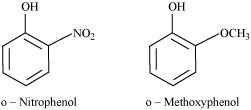
The nitro-group is an electron-withdrawing group. The presence of this group in the ortho position decreases the electron density in the O-H bond. As a result, it is easier to lose a proton. Also, the o-nitrophenoxide ion formed after the loss of protons is stabilized by resonance. Hence, ortho nitrophenol is a stronger acid.

On the other hand, methoxy group is an electron-releasing group. Thus, it increases the electron density in the O-H bond and hence, the proton cannot be given out easily.

For this reason, ortho-nitrophenol is more acidic than ortho-methoxyphenol.


A:

The -OH group is an electron-donating group. Thus, it increases the electron density in the benzene ring as shown in the given resonance structure of phenol.

As a result, the benzene ring is activated towards electrophilic substitution.


A:

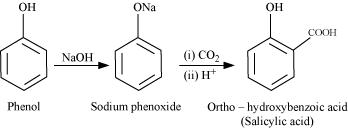
(i) Kolbe's reaction:

When phenol is treated with sodium hydroxide, sodium phenoxide is produced. This sodium phenoxide when treated with carbon dioxide, followed by acidification, undergoes electrophilic substitution to give ortho-hydroxybenzoic acid as the main product. This reaction is known as Kolbe's reaction.
 

(ii) Reimer-Tiemann reaction:

When phenol is treated with chloroform (CHCl3) in the presence of sodium hydroxide, a -CHO group is introduced at the ortho position of the benzene ring.

This reaction is known as the Reimer-Tiemann reaction.

The intermediate is hydrolyzed in the presence of alkalis to produce salicyclaldehyde.


(iii) Williamson ether synthesis:

Williamson ether synthesis is a laboratory method to prepare symmetrical and unsymmetrical ethers by allowing alkyl halides to react with sodium alkoxides.

This reaction involves SN2 attack of the alkoxide ion on the alkyl halide. Better results are obtained in case of primary alkyl halides.

If the alkyl halide is secondary or tertiary, then elimination competes over substitution.


(iv) Unsymmetrical ether:

An unsymmetrical ether is an ether where two groups on the two sides of an oxygen atom differ (i.e., have an unequal number of carbon atoms). For example: ethyl methyl ether (CH3-O-CH2CH3).


A:

The mechanism of acid dehydration of ethanol to yield ethene involves the following three steps:

Step 1:

Protonation of ethanol to form ethyl oxonium ion:

Step 2:

Formation of carbocation (rate determining step):

Step 3:

Elimination of a proton to form ethene:

The acid consumed in step 1 is released in Step 3. After the formation of ethene, it is removed to shift the equilibrium in a forward direction.


A:

(i) If propene is allowed to react with water in the presence of an acid as a catalyst, then propan-2-ol is obtained.

(ii) If benzyl chloride is treated with NaOH (followed by acidification) then benzyl alcohol is produced.

(iii) When ethyl magnesium chloride is treated with methanal, an adduct is the produced which gives propan-1-ol on hydrolysis.

(iv) When methyl magnesium bromide is treated with propane, an adduct is the product which gives 2-methylpropane-2-ol on hydrolysis.


A:

Ethanol undergoes intermolecular H-bonding due to the presence of -OH group, resulting in the association of molecules. Extra energy is required to break these hydrogen bonds. On the other hand, methoxymethane does not undergo H-bonding. Hence, the boiling point of ethanol is higher than that of methoxymethane.


A:

(i) 1-Ethoxy-2-methylpropane

(ii) 2-Chloro-1-methoxyethane

(iii) 4-Nitroanisole

(iv) 1-Methoxypropane

(v) 4-Ethoxy-1, 1-dimethylcyclohexane

(vi) Ethoxybenzene


A:

The reaction of Williamson synthesis involves SN2 attack of an alkoxide ion on a primary alkyl halide.

But if secondary or tertiary alkyl halides are taken in place of primary alkyl halides, then elimination would compete over substitution. As a result, alkenes would be produced. This is because alkoxides are nucleophiles as well as strong bases. Hence, they react with alkyl halides, which results in an elimination reaction.


A:

1-propoxypropane can be synthesized from propan-1-ol by dehydration.

Propan-1-ol undergoes dehydration in the presence of protic acids (such as H2SO4, H3PO4) to give 1-propoxypropane.

The mechanism of this reaction involves the following three steps:


A:

The formation of ethers by dehydration of alcohol is a bimolecular reaction (SN2) involving the attack of an alcohol molecule on a protonated alcohol molecule. In the method, the alkyl group should be unhindered. In case of secondary or tertiary alcohols, the alkyl group is hindered. As a result, elimination dominates substitution. Hence, in place of ethers, alkenes are formed.


A:

(i)


In aryl alkyl ethers, due to the +R effect of the alkoxy group, the electron density in the benzene ring increases as shown in the following resonance structure.

Thus, benzene is activated towards electrophilic substitution by the alkoxy group.


(ii) It can also be observed from the resonance structures that the electron density increases more at the ortho and para positions than at the meta position. As a result, the incoming substituents are directed to the ortho and para positions in the benzene ring.


A:

(i) The structures of all isomeric alcohols of molecular formula, C5H12O are shown below:


(ii) Primary alcohol: Pentan-1-ol; 2-Methylbutan-1-ol;

3-Methylbutan-1-ol; 2, 2 - Dimethylpropan-1-ol

Secondary alcohol: Pentan-2-ol; 3-Methylbutan-2-ol;

Pentan-3-ol

Tertiary alcohol: 2-methylbutan-2-ol


A:

The mechanism of the reaction of HI with methoxymethane involves the following steps:

Step3:

When HI is in excess and the reaction is carried out at a high temperature, the methanol formed in the second step reacts with another HI molecule and gets converted to methyl iodide


A:

Propanol undergoes intermolecular H-bonding because of the presence of -OH group. On the other hand, butane does not.

Thus, extra energy is required to break hydrogen bonds. For this reason, propanol has a higher boiling point than hydrocarbon butane.


A:

Alcohols form H-bonds with water due to the presence of -OH group. However, hydrocarbons cannot form H-bonds with water.

As a result, alcohols are comparatively more soluble in water than hydrocarbons of comparable molecular masses.


A:

The addition of borane followed by oxidation is known as the hydroboration-oxidation reaction. For example, propan-1-ol is produced by the hydroboration-oxidation reaction of propene. In this reaction, propene reacts with diborane (BH3)2 to form trialkyl borane as an addition product. This addition product is oxidized to alcohol by hydrogen peroxide in the presence of aqueous sodium hydroxide.


A:

Intramolecular H-bonding is present in o-nitrophenol. In p-nitrophenol, the molecules are strongly associated due to the presence of intermolecular bonding. Hence, o-nitrophenol is steam volatile.


A:

To prepare phenol, cumene is first oxidized in the presence of air of cumene hydro-peroxide.

Then, cumene hydroxide is treated with dilute acid to prepare phenol and acetone as by-products.


Exercise 1
A:

Primary alcohol → (i), (ii), (iii)

Secondary alcohol → (iv), (v)

Tertiary alcohol → (vi)


A:

In Williamson synthesis, an alkyl halide reacts with an alkoxide ion. Also, it is an SN2 reaction. In the reaction, alkyl halides should be primary having the least steric hindrance. Hence, an alkyl halide is obtained from ethanol and alkoxide ion from 3-methylpentan-2-ol.


A:

Set (ii) is an appropriate set of reactants for the preparation of 1-methoxy-4-nitrobenzene.

In set (i), sodium methoxide (CH3ONa) is a strong nucleophile as well as a strong base. Hence, an elimination reaction predominates over a substitution reaction.


A:

The alcohols given in (ii) and (vi) are allylic alcohols.


A:

(i) 3-Chloromethyl-2-isopropylpentan-1-ol

(ii) 2, 5-Dimethylhexane-1, 3-diol

(iii) 3-Bromocyclohexanol

(iv) Hex-1-en-3-ol

(v) 2-Bromo-3-methylbut-2-en-1-ol


A:

(a)

(i)

Primary alcohols do not react appreciably with Lucas' reagent (HCl-ZnCl2) at room temperature.

(ii)

Tertiary alcohols react immediately with Lucas' reagent.

(b)

(i)

(ii)

(c)

(i)

(ii)


A:

Resonance structure of the phenoxide ion

Resonance structures of p-nitrophenoxide ion

Resonance structures of o-nitrophenoxide ion

It can be observed that the presence of nitro groups increases the stability of phenoxide ion.


NCERT Textbook PDF

Use the available NCERT textbook PDF alongside the chapter solutions.

NCERT Exemplar

Use the mapped NCERT Exemplar resource for additional chapter practice.

Current Exemplar

Removed / Changed Chapters from the Syllabus

Current and historical curriculum records are shown separately so removed material is not mixed into current practice.

Previous / Removed Chapters

  • Chapter 1: The Solid State (rationalised)
  • Chapter 5: Surface Chemistry (rationalised)
  • Chapter 6: General Principles and Processes of Isolation of Elements (rationalised)
  • Chapter 7: The p-Block Elements (rationalised)
  • Chapter 15: Polymers (rationalised)
  • Chapter 16: Chemistry in Everyday Life (rationalised)

Frequently Asked Questions about Alcohols Phenols and Ethers - Class 12 Chemistry

    • 1. Is Alcohols Phenols and Ethers in the current curriculum?
    • This chapter is part of the verified current curriculum mapping for the academic session shown below. Verified academic session: 2026-27.
    • 2. How many NCERT solution entries are currently available for Alcohols Phenols and Ethers?
    • SaralStudy currently shows 2 visible solution entries on this chapter page.
    • 3. Are topic mappings available for Alcohols Phenols and Ethers?
    • No public topic mappings are currently available for this chapter.
    • 4. Are revision notes available for Alcohols Phenols and Ethers?
    • No verified chapter notes are currently available in this hub.

Latest Blog Posts

Stay updated with our latest educational content and study tips

How to Return to Work After a Career Break: Skills, Jobs and Preparation in 2026

It’s not about starting over if you took a break to care for children, take care of yourself, be healthy or for any other reason. This is a realistic strategy for the recovery of skills, selection of the right job, and overcoming the resume problem. One year, three years or 10 years of a career … Read more

Read More

Best Career Options After Class 12 for Average Students in 2026

There’s no need to score 95% or achieve a JEE/NEET rank. You don’t need to score 95% or rank in JEE/NEET to build a solid career. A candid and pragmatic guide to the routes that actually work for students who have an average mark and what to do when faced with the options. ​ If … Read more

Read More

Coaching vs Self-Study: Which is Best in 2026 for Competitive Exams?

AI tools, online platforms that are much cheaper than coaching centres and the changing idea of what “structure” even means have upended this argument more in the past two years than in the decade preceding it. Here’s what is really the case for 2026 – and what has actually stayed the same. If you look … Read more

Read More

Career Change After 30: How to Transition from Non-Tech to IT or Data Science

Starting to make a new career after 30 isn’t a start from scratch. Marketing, teaching, financial, retail, healthcare, sales and other professionals can pursue careers in technology by applying the existing knowledge and skills they have acquired to new technology skills. There are various ways to enter the technology industry, such as in IT support, … Read more

Read More

Benefits of Using Our NCERT Solutions for Class 12 Chemistry

When it comes to excelling in your studies, having a well-structured study guide can make a huge difference. Our NCERT Solutions for Class 12 Chemistry provide you with a comprehensive, easy-to-understand, and exam-focused resource that is specifically tailored to help you maximize your potential. Here are some of the key benefits of using our NCERT solutions for effective learning and high scores:

NCERT Solutions for Effective Exam Preparation

Preparing for exams requires more than just reading through textbooks. It demands a structured approach to understanding concepts, solving problems, and revising thoroughly. Here’s how our NCERT solutions can enhance your exam preparation:

  • Clear Understanding of Concepts: Our NCERT solutions are designed to break down complex topics into simple, understandable language, making it easier for students to grasp essential concepts in Chemistry. This helps in building a solid foundation for each chapter, which is crucial for scoring high marks.
  • Step-by-Step Solutions: Each solution is presented in a detailed, step-by-step manner. This approach not only helps you understand how to reach the answer but also equips you with the right techniques to tackle similar questions in exams.
  • Access to Important Questions: We provide a curated list of important questions and commonly asked questions in exams. By practicing these questions, you can familiarize yourself with the types of problems that are likely to appear in the exams and gain confidence in answering them.
  • Quick Revision Tool: Our NCERT solutions serve as an excellent tool for last-minute revision. The solutions cover all key points, definitions, and explanations, ensuring that you have everything you need to quickly review before exams.

Importance of Structured Answers for Scoring Higher Marks

In exams, it's not just about getting the right answer—it's also about presenting it in a well-structured and logical way. Our NCERT solutions for Class 12 Chemistry are designed to guide you on how to write answers that are organized and effective for scoring high marks.

  • Precise and Concise Answers: Our solutions are crafted to provide answers that are to the point, without unnecessary elaboration. This ensures that you don't waste time during exams and focus on delivering accurate answers that examiners appreciate.
  • Step-Wise Marks Distribution: We understand that exams often allot marks based on specific steps or points. Our NCERT solutions break down each answer into structured steps to ensure you cover all essential points required for full marks.
  • Improved Presentation Skills: By following the format of our NCERT solutions, you learn how to present your answers in a systematic and logical manner. This helps in making your answers easy to read and allows the examiner to quickly identify key points, resulting in better scores.
  • Alignment with NCERT Guidelines: Since exams are often set in alignment with NCERT guidelines, our solutions are tailored to follow the exact format and language that is expected in exams. This can improve your chances of scoring higher by meeting the examiner's expectations.
Keep learning

Discover More on SaralStudy

Explore all articles