Organisms and Population Question Answers: NCERT Class 12 Biology

Current NCERT chapter
Academic session 2026-27
2 Solutions · 0 Topics · 0 Notes resources

This chapter is part of the verified current curriculum mapping for the academic session shown below.

Chapter Details

Chapter
11 — Organisms and Populations
NCERT Book
Biology
Language
English
Edition
Academic session 2026-27

Use this Class 12 Biology chapter hub to study Organisms and Population from one place. SaralStudy currently provides 2 visible NCERT solution entries on this page.

NCERT Solutions

Review the SaralStudy solution entries currently available for this chapter.

Exercise 0
A:

Species existence, abundance and distribution in the ecosystem are defined by the range of tolerance to the environment variables. Shelford’s law of tolerance defines that there are upper and lower limit of tolerance threshold values on the environment gradient above or below amount of values, those species cannot survive. The organisms that can tolerate only a narrow range of temperature are known as stenothermal organisms. The prefix steno - means ‘narrow’ which have been used for the narrow range of tolerance of an organism to a given environmental factor.


A:

At the high altitude, sun is much closer than the plains and the dust particles are present at the lower concentration than plain surface, that’s why it contains brighter sunlight and contains various atmospheric gases which absorbs the sunlight. Low atmospheric pressure are present at the higher altitudes than the plains that leads to low temperature (cold).   


A:

Temperature is the important factor for controlling the rate of metabolic processes inside of an organism and in maintaining the homeostasis. Homeostasis is defined as the property of a living organism to regulate its internal environment to maintain a stable and constant condition under varying external environment.


A:

Aestivation is also known as the summer sleep and is prolonged torpor or dormancy of an insect, fish and other some animals during hot dry period; or we can say that is a state of dormancy characterized by inactivation and low metabolic rate in response to high temperature and dry conditions. For example: Ground squirrels of the South- western deserts undergoes summer sleep and lie dormant inside the burrows during hot dry periods.


A:

Diapause is a state of dormancy (the phase or a state of having suspension of physical activities or get slowed down for a period of time; deep sleep for some months) and arrested growth during the excessive heat and cold phase/ period that are usually found in insects, mites. Its significance is: it is a stage of suspended development that is initiated with the unfavorable conditions or when all the life processes are shut down that is most commonly observed in insects or zooplanktons adapt themselves to the unfavorable conditions in lakes or ponds.   


A:

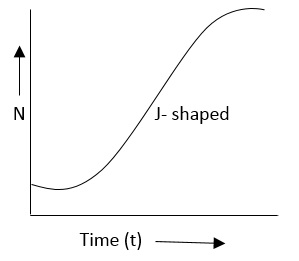
Population is a changing entity or keeps on changing in time and space. There are two types of population growth models have been proposed: J- shaped/ Exponential growth model, S- shaped/ Logistic growth model. In this question, the growth model or growth rate pattern will be exponential which describes the rate of expansion of a population under the ideal and unregulated conditions. This occurs when the resources are not limiting or unlimited and population is small. The exponential form of growth may be represented by the simple model which is based on this equation;

equation

Where, N is the population size

r is the intrinsic rate of increase;

  • If r is positive then the population is increasing
  • If r is positive then the population is decreasing
  • If r is zero then the population does not change in size

dN/dt is the change of population numbers over the time

Exponential growth curve where resources in habitat are unlimited, all the members of species have the ability to grow exponentially. Shows J- shaped growth curve when the population size (N) (that increases exponentially at the constant rate) is plotted over the time (t). Diagrammatic representation:

 growth curve


A:

The organisms which feeds on green plants or the parts of the plants are known as phytophagous insects or organisms. The most common example is Bugs. These species mainly includes insect’s order like Orthoptera, Lepidoptera etc.  


A:

Altitude sickness occurs when you cannot get enough oxygen from the air at high altitude.

Symptoms: Dizziness, headache, shortness of breath, nausea etc.


A:

No organisms live in isolation and influence each other’s life by directly or indirectly. This interdependence reflected in their interactions for food, space, reproduction and protection which are important for the survival. Commensalism is considered as the positive interaction and is a symbiotic relationship between the two species in which one species is benefitted and other neither benefits or nor is harmed. For example: climbers takes tree’s support for exposing their canopy without doing harm to the tree itself.


A:

A parasite is an organism which obtains its nutrients from one or a very few host individuals that cause harm but not responsible for immediate death. These can be temporary (which comes in contact with host for a short period, example: female mosquitoes like Ades, Culex) or permanent (which remains in contact with the host throughout their life, example: Entamoeba histolytica). Depending on either parasites live within the host or on the host, are classified into two categories: Ectoparasite and Endoparasite.   

Ectoparasite: Parasites that lives on the surface of the host are known as Ectoparasite. For example: some mites, lice on humans and ticks on dogs.

Endoparasite: Parasites that lives inside the body of host are known as Endoparasite. For example: Hookworms that lives inside the host’s gut, the human liver fluke (a trematode parasite).


A:

Parasitism explains the association of two organisms of different size and different species in which one species get benefitted (parasite) and other one got harmed (host). Parasites got nourishment from the host. Brood parasites are organisms which lays their eggs and leave them on others nest to raise their young ones. Brood parasitism is an example of parasitism which is commonly shown in birds. They lays their egg in the nest of the foster mother or in the others nest (host). And, then after the eggs when got evolved in size and colour, they get eject from the host’s nest.  


A:

Species existence, abundance and distribution in the ecosystem are defined by the range of tolerance to the environment variables. Shelford’s law of tolerance defines that there are upper and lower limit of tolerance threshold values on the environment gradient above or below amount of values, those species cannot survive. The organisms which have wide range of temperature tolerance are known as eurythermal or eurythermic organisms. The prefix eury - means ‘wide’ which have been used for the wide range of tolerance of an organism to a given environmental factor.


A:

Species existence, abundance and distribution in the ecosystem are defined by the range of tolerance to the environment variables. Shelford’s law of tolerance defines that there are upper and lower limit of tolerance threshold values on the environment gradient above or below amount of values, those species cannot survive. As the upper and lower limit/range of tolerance of temperature factor is known is eury and stenothermal organisms; similarly the species that can tolerate wide range of salinity are known as euryhaline. 


A:

Tolerance ranges different for one species to another. According to the Shelford’s law of tolerance, there are upper and lower limit of tolerance threshold values on the environment gradient beyond the species cannot survive. As the upper and lower limit/range of tolerance of temperature factor is known is eury and stenothermal organisms; similarly the species that can tolerate narrow range of salinity are known as stenohaline species. 


A:

Species interaction explains most of the attributes of ecology and the population can be very much affected by the interactions between the organisms in the ecosystem. When the interaction occurs between the two same species, are called intra- specific interaction; and when the interaction occurs between two different species are known inter- specific interaction; or the interaction between two organisms living together in intimate association or even the merging of two different organisms are known as Symbiosis which is always inter- specific where at least one species benefits. Interactions are broadly categorized into three: Positive, Negative and Neutral; only depends on the nature of the effect on interacting species.    


A:

No organisms live in isolation and influence each other’s life by directly or indirectly. This interdependence reflected in their interactions for food, space, reproduction and protection which are important for the survival. Commensalism is considered as the positive interaction and is a symbiotic relationship between the two species in which one species is benefitted and other neither benefits or nor is harmed.


A:

Amensalism

It is the type of negative interaction in which one species causing harm to another species with its toxic secretion, often without gaining any benefit from the interaction. A good example of this interaction is when an organism produces antibiotic against another organism. Various molds, Penicillium, secrete chemicals that kills other bacteria in their vicinity (the area surrounding a particular place). 


A:

Mycorrhizae means the fungus roots and is mutualistic association between fungi and plant roots. Mycorrhizal fungi supplies inorganic nutrients like phosphate, calcium and water to the plants, which they are able to extract from the soil efficiently and in exchange plant supplies the fungi with organic nutrients. Almost 90% of the seed plants have the mutualistic association with fungi.


A:

The species that can tolerate wide range of salinity are known as euryhaline. Like Mangroves are the emergent land plants that are constantly under varied environmental stress conditions including high salinity conditions, string wind velocity, high temperature and these plants have adapted themselves to the fluctuation changes. Mangroves are a group of shrubs that lives in the land- sea ecotone zone of tropical and subtropical latitudes; and are found coastal areas along sea shores.   


Exercise 1
A:

Diapause is a stage of suspended development to cope with unfavourable conditions. Many species of Zooplankton and insects exhibit diapause to tide over adverse climatic conditions during their development.

Hibernation or winter sleep is a resting stage where in animals escape winters (cold) by hiding themselves in their shelters. They escape the winter season by entering a state of inactivity by slowing their metabolism. The phenomenon of hibernation is exhibited by bats, squirrels, and other rodents.


A:

(a) Hibernation and Aestivation


Hibernation


Aestivation

1.

Hibernation is a state of reduced activity in some organisms to escape cold winter conditions.

1.

Aestivation is a state of reduced activity in some organisms to escape desiccation due to heat in summers.

2.

Bears and squirrels inhabiting cold regions are examples of animals that hibernate during winters.

2.

Fishes and snails are examples of organisms aestivating during summers.

(b) Ectotherms and Endotherms


Ectotherms


Endotherms

1.

Ectotherms are cold blooded animals. Their temperature varies with their surroundings.

1.

Endotherms are warm blooded animals. They maintain a constant body temperature.

2.

Fishes, amphibians, and reptiles are ectothermal animals.

2

Birds and mammals are endothermal animals.


A:

(a) Adaptations of desert plants and animals:

(i) Adaptations of desert plants:

Plants found in deserts are well adapted to cope with harsh desert conditions such as water scarcity and scorching heat. Plants have an extensive root system to tap underground water. They bear thick cuticles and sunken stomata on the surface of their leaves to reduce transpiration. In Opuntia, the leaves are entirely modified into spines and photosynthesis is carried out by green stems. Desert plants have special pathways to synthesize food, called CAM (C4 pathway). It enables the stomata to remain closed during the day to reduce the loss of water through transpiration.

(ii) Adaptations of desert animals:

Animals found in deserts such as desert kangaroo rats, lizards, snakes, etc. are well adapted to their habitat. The kangaroo rat found in the deserts of Arizona never drinks water in its life. It has the ability to concentrate its urine to conserve water. Desert lizards and snakes bask in the sun during early morning and burrow themselves in the sand during afternoons to escape the heat of the day. These adaptations occur in desert animals to prevent the loss of water.

(b) Adaptations of plants to water scarcity

Plants found in deserts are well adapted to cope with water scarcity and scorching heat of the desert. Plants have an extensive root system to tap underground water. They bear thick cuticles and sunken stomata on the surface of their leaves to reduce transpiration. In Opuntia, the leaves are modified into spines and the process of photosynthesis is carried out by green stems. Desert plants have special pathways to synthesize food, called CAM (C4 pathway). It enables their stomata to remain closed during the day to reduce water loss by transpiration.

(c) Behavioural adaptations in animals

Certain organisms are affected by temperature variations. These organisms undergo adaptations such as hibernation, aestivation, migration, etc. to escape environmental stress to suit their natural habitat. These adaptations in the behaviour of an organism are called behavioural adaptations. For example, ectothermal animals and certain endotherms exhibit behavioral adaptations. Ectotherms are cold blooded animals such as fish, amphibians, reptiles, etc. Their temperature varies with their surroundings. For example, the desert lizard basks in the sun during early hours when the temperature is quite low. However, as the temperature begins to rise, the lizard burrows itself inside the sand to escape the scorching sun. Similar burrowing strategies are exhibited by other desert animals. Certain endotherms (warm-blooded animals) such as birds and mammals escape cold and hot weather conditions by hibernating during winters and aestivating during summers. They hide themselves in shelters such as caves, burrows, etc. to protect against temperature variations.

(d) Importance of light to plants

Sunlight acts as the ultimate source of energy for plants. Plants are autotrophic organisms, which need light for carrying out the process of photosynthesis. Light also plays an important role in generating photoperiodic responses occurring in plants. Plants respond to changes in intensity of light during various seasons to meet their photoperiodic requirements for flowering. Light also plays an important role in aquatic habitats for vertical distribution of plants in the sea.

(e) Effects of temperature or water scarcity and the adaptations of animals.

Temperature is the most important ecological factor. Average temperature on the Earth varies from one place to another. These variations in temperature affect the distribution of animals on the Earth. Animals that can tolerate a wide range of temperature are called eurythermals. Those which can tolerate a narrow range of temperature are called stenothermal animals. Animals also undergo adaptations to suit their natural habitats. For example, animals found in colder areas have shorter ears and limbs that prevent the loss of heat from their body. Also, animals found in Polar regions have thick layers of fat below their skin and thick coats of fur to prevent the loss of heat.

Some organisms exhibit various behavioural changes to suit their natural habitat. These adaptations present in the behaviour of an organism to escape environmental stresses are called behavioural adaptations. For example, desert lizards are ectotherms. This means that they do not have a temperature regulatory mechanism to escape temperature variations. These lizards bask in the sun during early hours when the temperature is quite low. As the temperature begins to increase, the lizard burrows itself inside the sand to escape the scorching sun. Similar burrowing strategy is seen in other desert animals.

Water scarcity is another factor that forces animals to undergo certain adaptations to suit their natural habitat. Animals found in deserts such as desert kangaroo rats, lizards, snakes, etc. are well adapted to stay in their habitat. The kangaroo rat found in the deserts of Arizona never drinks water in its life. It has the ability to concentrate its urine to conserve water. Desert lizards and snakes bask in the sun during early morning and burrow in the sand as the temperature rises to escape the heat of the day. Such adaptations can be seen to prevent the loss of water.


A:

All non- living components of an ecosystem form abiotic components. It includes factors such as temperature, water, light, and soil.


A:

(a) Endothermic animal: Birds such as crows, sparrows, pigeons, cranes, etc. and mammals such as bears, cows, rats, rabbits, etc. are endothermic animals.

(b) Ectothermic animal: Fishes such as sharks, amphibians such as frogs, and reptiles such as tortoise, snakes, and lizards are ectothermic animals.

(c) Organism of benthic zone: Decomposing bacteria is an example of an organism found in the benthic zone of a water body.


A:

Population:

A population can be defined as a group of individuals of the same species residing in a particular geographical area at a particular time and functioning as a unit. For example, all human beings living at a particular place at a particular time constitute the population of humans.

Community:

A community is defined as a group of individuals of different species, living within a certain geographical area. Such individuals can be similar or dissimilar, but cannot reproduce with the members of other species.


A:

(a) Commensalism: Commensalism is an interaction between two species in which one species gets benefited while the other remains unaffected. An orchid growing on the branches of a mango tree and barnacles attached to the body of whales are examples of commensalisms.

(b) Parasitism: It is an interaction between two species in which one species (usually smaller) gets positively affected, while the other species (usually larger) is negatively affected. An example of this is liver fluke. Liver fluke is a parasite that lives inside the liver of the host body and derives nutrition from it. Hence, the parasite is benefited as it derives nutrition from the host, while the host is negatively affected as the parasite reduces the host fitness, making its body weak.

(c) Camouflage: It is a strategy adapted by prey species to escape their predators. Organisms are cryptically coloured so that they can easily mingle in their surroundings and escape their predators. Many species of frogs and insects camouflage in their surroundings and escape their predators.

(d) Mutualism: It is an interaction between two species in which both species involved are benefited. For example, lichens show a mutual symbiotic relationship between fungi and blue green algae, where both are equally benefited from each other.

(e) Interspecific competition: It is an interaction between individuals of different species where both species get negatively affected. For example, the competition between flamingoes and resident fishes in South American lakes for common food resources i.e., zooplankton.


A:

The logistic population growth curve is commonly observed in yeast cells that are grown under laboratory conditions. It includes five phases: the lag phase, positive acceleration phase, exponential phase, negative acceleration phase, and stationary phase.

(a) Lag phase: Initially, the population of the yeast cell is very small. This is because of the limited resource present in the habitat.

(b) Positive acceleration phase: During this phase, the yeast cell adapts to the new environment and starts increasing its population. However, at the beginning of this phase, the growth of the cell is very limited.

(c) Exponential phase: During this phase, the population of the yeast cell increases suddenly due to rapid growth. The population grows exponentially due to the availability of sufficient food resources, constant environment, and the absence of any interspecific competition. As a result, the curve rises steeply upwards.

(d) Negative acceleration phase: During this phase, the environmental resistance increases and the growth rate of the population decreases. This occurs due to an increased competition among the yeast cells for food and shelter.

(e) Stationary phase: During this phase, the population becomes stable. The number of cells produced in a population equals the number of cells that die. Also, the population of the species is said to have reached nature’s carrying-capacity in its habitat. A Verhulst−pearl logistic curve is also known as an S-shaped growth curve.


A:

(d) One organism is benefited, other is affected.

Parasitism is an interaction between two species in which one species (parasite) derives benefit while the other species (host) is harmed. For example, ticks and lice (parasites) present on the human body represent this interaction where in the parasites receive benefit (as they derive nourishment by feeding on the blood of humans). On the other hand, these parasites reduce host fitness and cause harm to the human body.


A:

A population can be defined as a group of individuals of the same species, residing in a particular geographical area at a particular time and functioning as a unit. For example, all human beings living at a particular place at a particular time constitute the population of humans.

Three important characteristics of a population are:

(a) Birth rate (Natality): It is the ratio of live births in an area to the population of an area. It is expressed as the number of individuals added to the population with respect to the members of the population.

(b) Death rate (Mortality): It is the ratio of deaths in an area to the population of an area. It is expressed as the loss of individuals with respect to the members of the population.

(c) Age Distribution: It is the percentage of individuals of different ages in a given population. At any given time, a population is composed of individuals that are present in various age groups. The age distribution pattern is commonly represented through age pyramids.


A:

If a marine fish is placed in a fresh water aquarium, then its chances of survival will diminish. This is because their bodies are adapted to high salt concentrations of the marine environment. In fresh water conditions, they are unable to regulate the water entering their body (through osmosis). Water enters their body due to the hypotonic environment outside. This results in the swelling up of the body, eventually leading to the death of the marine fish.


A:

Phenotypic adaptation involves changes in the body of an organism in response to genetic mutation or certain environmental changes. These responsive adjustments occur in an organism in order to cope with environmental conditions present in their natural habitats. For example, desert plants have thick cuticles and sunken stomata on the surface of their leaves to prevent transpiration. Similarly, elephants have long ears that act as thermoregulators.


A:

Archaebacteria (Thermophiles) are ancient forms of bacteria found in hot water springs and deep sea hydrothermal vents. They are able to survive in high temperatures (which far exceed 100°C) because their bodies have adapted to such environmental conditions. These organisms contain specialized thermo-resistant enzymes, which carry out metabolic functions that do not get destroyed at such high temperatures.


A:

A population can be defined as a group of individuals of the same species residing in a particular geographical area at a particular time and functioning as a unit. For example, all human beings living at a particular place at a particular time constitute the population of humans.

The main attributes or characteristics of a population residing in a given area are:-

(a) Birth rate (Natality): It is the ratio of live births in an area to the population of an area. It is expressed as the number of individuals added to the population with respect to the members of the population.

(b) Death rate (Mortality): It is the ratio of deaths in an area to the population of an area. It is expressed as the loss of individuals with respect to the members of the population.

(c) Sex ratio: It is the number of males or females per thousand individuals.

(d) Age Distribution: It is the percentage of individuals of different ages in a given population. At any given time, the population is composed of individuals that are present in various age groups. The age distribution pattern is commonly represented through age pyramids.

(e) Population density: It is defined as the number of individuals of a population present per unit area at a given time.


A:

A population grows exponentially if sufficient amounts of food resources are available to the individual. Its exponential growth can be calculated by the following integral form of the exponential growth equation:

Nt = No ert

Where,

Nt= Population density after time t

NO= Population density at time zero

r = Intrinsic rate of natural increase

e = Base of natural logarithms (2.71828)

From the above equation, we can calculate the intrinsic rate of increase (r) of a population.

Now, as per the question,

Present population density = x

Then,

Population density after two years = 2x

t = 3 years

Substituting these values in the formula, we get:

⇒ 2x = x e3r

⇒ 2 = e3r

Applying log on both sides:

⇒ log 2 = 3r log e

Intrinsic Rate Of Increase

Hence, the intrinsic rate of increase for the above illustrated population is 0.2311.


A:

Several plants have evolved various mechanisms both morphological and chemical to protect themselves against herbivory.

(1) Morphological defence mechanisms:

(a) Cactus leaves (Opuntia) are modified into sharp spines (thorns) to deter herbivores from feeding on them.

(b) Sharp thorns along with leaves are present in Acacia to deter herbivores.

(c) In some plants, the margins of their leaves are spiny or have sharp edges that prevent herbivores from feeding on them.

(2) Chemical defence mechanisms:

(a) All parts of Calotropis weeds contain toxic cardiac glycosides, which can prove to be fatal if ingested by herbivores.

(b) Chemical substances such as nicotine, caffeine, quinine, and opium are produced in plants as a part of self-defense.


A:

An orchid growing on the branch of a mango tree is an epiphyte. Epiphytes are plants growing on other plants which however, do not derive nutrition from them. Therefore, the relationship between a mango tree and an orchid is an example of commensalisms, where one species gets benefited while the other remains unaffected. In the above interaction, the orchid is benefited as it gets support while the mango tree remains unaffected.


A:

The basis of various biological control methods is on the concept of predation. Predation is a biological interaction between the predator and the prey, whereby the predator feeds on the prey. Hence, the predators regulate the population of preys in a habitat, thereby helping in the management of pest insects.


NCERT Textbook PDF

Use the available NCERT textbook PDF alongside the chapter solutions.

NCERT Exemplar

Use the mapped NCERT Exemplar resource for additional chapter practice.

Current Exemplar

Practice This Chapter

Only live, verified assessment resources for the current curriculum are shown.

Removed / Changed Chapters from the Syllabus

Current and historical curriculum records are shown separately so removed material is not mixed into current practice.

Previous / Removed Chapters

  • Chapter 1: Reproduction in Organisms (rationalised)
  • Chapter 9: Strategies for Enhancement in Food Production (rationalised)
  • Chapter 16: Environmental Issues (rationalised)

Frequently Asked Questions about Organisms and Population - Class 12 Biology

    • 1. Is Organisms and Population in the current curriculum?
    • This chapter is part of the verified current curriculum mapping for the academic session shown below. Verified academic session: 2026-27.
    • 2. How many NCERT solution entries are currently available for Organisms and Population?
    • SaralStudy currently shows 2 visible solution entries on this chapter page.
    • 3. Are topic mappings available for Organisms and Population?
    • No public topic mappings are currently available for this chapter.
    • 4. Are revision notes available for Organisms and Population?
    • No verified chapter notes are currently available in this hub.

Latest Blog Posts

Stay updated with our latest educational content and study tips

How to Return to Work After a Career Break: Skills, Jobs and Preparation in 2026

It’s not about starting over if you took a break to care for children, take care of yourself, be healthy or for any other reason. This is a realistic strategy for the recovery of skills, selection of the right job, and overcoming the resume problem. One year, three years or 10 years of a career … Read more

Read More

Best Career Options After Class 12 for Average Students in 2026

There’s no need to score 95% or achieve a JEE/NEET rank. You don’t need to score 95% or rank in JEE/NEET to build a solid career. A candid and pragmatic guide to the routes that actually work for students who have an average mark and what to do when faced with the options. ​ If … Read more

Read More

Coaching vs Self-Study: Which is Best in 2026 for Competitive Exams?

AI tools, online platforms that are much cheaper than coaching centres and the changing idea of what “structure” even means have upended this argument more in the past two years than in the decade preceding it. Here’s what is really the case for 2026 – and what has actually stayed the same. If you look … Read more

Read More

Career Change After 30: How to Transition from Non-Tech to IT or Data Science

Starting to make a new career after 30 isn’t a start from scratch. Marketing, teaching, financial, retail, healthcare, sales and other professionals can pursue careers in technology by applying the existing knowledge and skills they have acquired to new technology skills. There are various ways to enter the technology industry, such as in IT support, … Read more

Read More

Benefits of Using Our NCERT Solutions for Class 12 Biology

When it comes to excelling in your studies, having a well-structured study guide can make a huge difference. Our NCERT Solutions for Class 12 Biology provide you with a comprehensive, easy-to-understand, and exam-focused resource that is specifically tailored to help you maximize your potential. Here are some of the key benefits of using our NCERT solutions for effective learning and high scores:

NCERT Solutions for Effective Exam Preparation

Preparing for exams requires more than just reading through textbooks. It demands a structured approach to understanding concepts, solving problems, and revising thoroughly. Here’s how our NCERT solutions can enhance your exam preparation:

  • Clear Understanding of Concepts: Our NCERT solutions are designed to break down complex topics into simple, understandable language, making it easier for students to grasp essential concepts in Biology. This helps in building a solid foundation for each chapter, which is crucial for scoring high marks.
  • Step-by-Step Solutions: Each solution is presented in a detailed, step-by-step manner. This approach not only helps you understand how to reach the answer but also equips you with the right techniques to tackle similar questions in exams.
  • Access to Important Questions: We provide a curated list of important questions and commonly asked questions in exams. By practicing these questions, you can familiarize yourself with the types of problems that are likely to appear in the exams and gain confidence in answering them.
  • Quick Revision Tool: Our NCERT solutions serve as an excellent tool for last-minute revision. The solutions cover all key points, definitions, and explanations, ensuring that you have everything you need to quickly review before exams.

Importance of Structured Answers for Scoring Higher Marks

In exams, it's not just about getting the right answer—it's also about presenting it in a well-structured and logical way. Our NCERT solutions for Class 12 Biology are designed to guide you on how to write answers that are organized and effective for scoring high marks.

  • Precise and Concise Answers: Our solutions are crafted to provide answers that are to the point, without unnecessary elaboration. This ensures that you don't waste time during exams and focus on delivering accurate answers that examiners appreciate.
  • Step-Wise Marks Distribution: We understand that exams often allot marks based on specific steps or points. Our NCERT solutions break down each answer into structured steps to ensure you cover all essential points required for full marks.
  • Improved Presentation Skills: By following the format of our NCERT solutions, you learn how to present your answers in a systematic and logical manner. This helps in making your answers easy to read and allows the examiner to quickly identify key points, resulting in better scores.
  • Alignment with NCERT Guidelines: Since exams are often set in alignment with NCERT guidelines, our solutions are tailored to follow the exact format and language that is expected in exams. This can improve your chances of scoring higher by meeting the examiner's expectations.
Keep learning

Discover More on SaralStudy

Explore all articles