Biodiversity and Conservation Question Answers: NCERT Class 12 Biology

Current NCERT chapter
Academic session 2026-27
2 Solutions · 0 Topics · 0 Notes resources

This chapter is part of the verified current curriculum mapping for the academic session shown below.

Chapter Details

Chapter
13 — Biodiversity and its Conservation
NCERT Book
Biology
Language
English
Edition
Academic session 2026-27

Use this Class 12 Biology chapter hub to study Biodiversity and Conservation from one place. SaralStudy currently provides 2 visible NCERT solution entries on this page.

NCERT Solutions

Review the SaralStudy solution entries currently available for this chapter.

Exercise 0
A:

The community refers to the assemblage of population of various different species which occurs together in the same geographical area or habitat and at same time. Community shows both functional and structural unity. The stable community in the series is called as the climax community. Characteristics that makes the community stable are as follows:

  1. It inhibits the invasion of the alien species.
  2. The stable community should be mature, stable, self -sustaining etc.
  3. The vegetation will be tolerant of environmental conditions.
  4. It must contains variety of species, complex food chains etc.
  5. It should contain the greater biodiversity for the stability.
  6. This is said to be balanced community and contains equilibrium state between the gross primary production and total respiration etc.
  7. It persists as long as the climatic and physiographic condition remains unchanged and we can say it is unreplaceable.

A:

The World Conservation Union (WCU) which were primarily called IUCN (International Union of conservation of Nature and Natural resources) maintains a document in which it contains all the information about the species that are facing high risk of extinction is called Red list or Red Data Book. Species are classified mainly by the IUCN Red list into the nine groups which are based on the following factors: declining rate, population size, area of geographic distribution and degree of population distribution and at last fragmentation. 


A:

Gene pool refers to the sum of all the genotypes of all the individuals in an inbreeding (mating of organisms which are closely related by ancestry) population. For example: Fishes in the rivers, streams, lake or pond etc.; tress in the forest etc.   


A:

Plants are the sources of food for many organisms which are known as herbivores. Frugivorous are the type of herbivores organisms which feeds on fleshy fruits. Birds are the most common example of vertebrate frugivorous organisms.  


A:

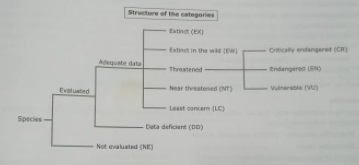
IUCN stands for International Union for the Conservation of Nature and Natural Resources, is an organization which works in the field of nature conservation and sustainable use of natural resources. This IUCN Red list criteria is the defined system for those classified species that are facing high risk of extinction. This list contains nine groups which is shown in this diagram below:

  categories


A:

(i) Bioprospecting: Bioprospecting refers to the systematic and organized way of exploration of natural resources for various useful products that are introduced from bioresources (natural renewable resources) like plants, microorganisms, animals, etc., which can further be used commercially so that we can get overall benefits for the agricultural (for the energy carriers), aquaculture, bioremediation (it describes the use of microbes which cleaned up the contaminants from the environment), cosmetics or pharmaceutical industries etc.

(ii) Endemism or endemic species: Endemism represents those species which are native (originated there) to a particular geographic area or continent and do not found anywhere else. For example: Koala bear, the Red Kangaroo etc.   


A:

They both figure A and B are the angiospermic flowering plants. Angiosperms are the large group of plants and are dominant. They form various groups of seed plants which shows presence of flowers, double fertilization, presence of xylem vessels etc. that makes them flowering plants by shows these characters.  


A:

Figure A is the tiger (mammal) and Figure B is a snake (reptile), both belongs to the vertebrates. And, they both are the predators; tiger is the top predator, but snakes sometimes acts as the predator and sometimes it being captured by the owl, haws as the prey to them. 


A:

Co-extinction refers to that when species becomes extinct by any reason, the plants and the animal species which are bind to those species in the obligatory way, also becomes extinct. For example: in case of plant- pollinator mutualism; the pollinators when feed on nectar it helps in growing the plant and helps in making the fruits in any way. If the pollinator become extinct then the plant will automatically become extinct and so as in case of plants.


A:

Extinction is a natural process which refers to the complete disappearance of a species from the Earth and this process is very important for the evolution of the life on Earth. In the ancient times, huge number of species on the Earth became extinct due to the catastrophes which is known as mass extinction. There are several activities occurs that triggers the mass extinction of the species in the past:

  1. Volcanic eruption
  2. Sea level changes
  3. Glaciation etc.

A:

Ecosystem includes all the various types of species, different types of ecosystem (aquatic, terrestrial) and the habitats or the abiotic factors which is also known as the ecological diversity. Ecosystem diversity also describes the trophic levels, niches, various biogeochemical processes, energy flow, food chain, food web etc. Or we can say that it describes the diversity at the ecosystem level. Deserts, rain forests, coral reefs, estuaries, wetlands etc. in India has the greater ecosystem diversity.


A:

The man- made ecosystem or artificial ecosystem like agricultural field of paddy or wheat crop show very low diversity, but possess high productivity. These are also an example of monoculture (cultivation of single crop).


A:

The word ‘Red’ indicates or represents those species which are facing high risk of extinction and are threatened. 


A:

Biodiversity hotspots are the place which are biologically richest and are deeply threatened which are included in 6 continents. They are distributed along the shore lines and near the equator and covers almost 1.4% of the world land. These hot spots contains high number of endemic species under their strict protection, which could help in the reduction of extinction by approximate 30%. 


A:

Endemism or endemic species: Endemism represents those species which are native (originated there) to a particular geographic area or continent. For example: Koala bear, the Red Kangaroo etc.   

Exotic species: An invasive species are also called exotic or non- native species and have the tendency to damage the ecosystem. They include several common characteristics like rapid reproduction and growth, high dispersal ability, can adapt themselves physiologically according to the new conditions. For example: Eichhornia, Cane toad etc.


A:

Biodiversity contains three levels: Genetic diversity, Species diversity and Ecological diversity. Species and ecological diversity are different from each other:

Species diversity: It refers to the various types of species within a particular region which is known as species richness. Species diversity includes species richness, species evenness as well as phylogenetic diversity (represents genetic relationship between different groups of species). Or we can say that it describes the diversity at the species level.

Ecosystem diversity: It includes all the various types of species and the abiotic factors. Ecosystem diversity also describes the trophic levels, niches, various biogeochemical processes, energy flow, food chain, food web etc. Or we can say that it describes the diversity at the ecosystem level. 


A:

Genetic variation leads to the evolution by the mutation in the organism which forms the new characteristics. Rauwolfia vomitorial (contains alkaloids which are used in medicine) is a medicinal herb plant in which genetic variation leads to the production of drug reserpine that are used to treat various patients that are suffering from hypertension and the mental illness.


Exercise 1
A:

Biodiversity is the variety of living forms present in various ecosystems. It includes variability among life forms from all sources including land, air, and water. Three important components of biodiversity are:

(a) Genetic diversity

(b) Species diversity

(c) Ecosystem diversity


A:

Yes, there are various kinds of parasites and disease-causing microbes that we deliberately want to eradicate from the Earth. Since these micro-organisms are harmful to human beings, scientists are working hard to fight against them. Scientists have been able to eliminate small pox virus from the world through the use of vaccinations. This shows that humans deliberately want to make these species extinct. Several other eradication programmes such as polio and Hepatitis B vaccinations are aimed to eliminate these disease-causing microbes.


A:

The diversity of living organisms present on the Earth is very vast. According to an estimate by researchers, it is about seven millions.

The total number of species present in the world is calculated by ecologists by statistical comparison between a species richness of a well studied group of insects of temperate and tropical regions. Then, these ratios are extrapolated with other groups of plants and animals to calculate the total species richness present on the Earth.


A:

There are three different hypotheses proposed by scientists for explaining species richness in the tropics.

(1) Tropical latitudes receive more solar energy than temperate regions, which leads to high productivity and high species diversity.

(2) Tropical regions have less seasonal variations and have a more or less constant environment. This promotes the niche specialization and thus, high species richness.

(3) Temperate regions were subjected to glaciations during the ice age, while tropical regions remained undisturbed which led to an increase in the species diversity in this region.


A:

The slope of regression (z) has a great significance in order to find a species-area relationship. It has been found that in smaller areas (where the species-area relationship is analyzed), the value of slopes of regression is similar regardless of the taxonomic group or the region. However, when a similar analysis is done in larger areas, then the slope of regression is much steeper.


A:

Biodiversity is the variety of living forms present in various ecosystems. It includes variability among life forms from all sources including land, air, and water. Biodiversity around the world is declining at a very fast pace. The following are the major causes for the loss of biodiversity around the world.

(i) Habitat loss and fragmentation: Habitats of various organisms are altered or destroyed by uncontrolled and unsustainable human activities such as deforestation, slash and burn agriculture, mining, and urbanization. This results in the breaking up of the habitat into small pieces, which effects the movement of migratory animals and also, decreases the genetic exchange between populations leading to a declination of species.

(ii) Over-exploitation: Due to over-hunting and over-exploitation of various plants and animals by humans, many species have become endangered or extinct (such as the tiger and the passenger pigeon).

(iii) Alien species Invasions: Accidental or intentional introduction of non-native species into a habitat has also led to the declination or extinction of indigenous species. For example, the Nile perch introduced in Lake Victoria in Kenya led to the extinction of more than two hundred species of native fish in the lake.

(iv) Co­−extinction: In a native habitat, one species is connected to the other in an intricate network. The extinction of one species causes the extinction of other species, which is associated with it in an obligatory way. For example, the extinction of the host will cause the extinction of its parasites.

A:

An ecosystem with high species diversity is much more stable than an ecosystem with low species diversity. Also, high biodiversity makes the ecosystem more stable in productivity and more resistant towards disturbances such as alien species invasions and floods.

If an ecosystem is rich in biodiversity, then the ecological balance would not get affected. As we all know, various trophic levels are connected through food chains. If any one organism or all organisms of any one trophic level is killed, then it will disrupt the entire food chain. For example, in a food chain, if all plants are killed, then all deer’s will die due to the lack of food. If all deer’s are dead, soon the tigers will also die. Therefore, it can be concluded that if an ecosystem is rich in species, then there will be other food alternatives at each trophic level which would not allow any organism to die due to the absence of their food resource.

Hence, biodiversity plays an important role in maintaining the health and ecological balance of an ecosystem.


A:

Sacred groves are tracts of forest which are regenerated around places of worship. Sacred groves are found in Rajasthan, Western Ghats of Karnataka,and Maharashtra, Meghalaya, and Madhya Pradesh. Sacred groves help in the protection of many rare, threatened, and endemic species of plants and animals found in an area. The process of deforestation is strictly prohibited in this region by tribals. Hence, the sacred grove biodiversity is a rich area.


A:

The biotic components of an ecosystem include the living organisms such as plants and animals. Plants play a very important role in controlling floods and soil erosion. The roots of plants hold the soil particles together, thereby preventing the top layer of the soil to get eroded by wind or running water. The roots also make the soil porous, thereby allowing ground water infiltration and preventing floods. Hence, plants are able to prevent soil erosion and natural calamities such as floods and droughts. They also increase the fertility of soil and biodiversity.


A:

More than 70 percent of species recorded on the Earth are animals and only 22 percent species are plants. There is quiet a large difference in their percentage. This is because animals have adapted themselves to ensure their survival in changing environments in comparison to plants. For example, insects and other animals have developed a complex nervous system to control and coordinate their body structure. Also, repeated body segments with paired appendages and external cuticles have made insects versatile and have given them the ability to survive in various habitats as compared to other life forms.


NCERT Textbook PDF

Use the available NCERT textbook PDF alongside the chapter solutions.

NCERT Exemplar

Use the mapped NCERT Exemplar resource for additional chapter practice.

Current Exemplar

Practice This Chapter

Only live, verified assessment resources for the current curriculum are shown.

Removed / Changed Chapters from the Syllabus

Current and historical curriculum records are shown separately so removed material is not mixed into current practice.

Previous / Removed Chapters

  • Chapter 1: Reproduction in Organisms (rationalised)
  • Chapter 9: Strategies for Enhancement in Food Production (rationalised)
  • Chapter 16: Environmental Issues (rationalised)

Frequently Asked Questions about Biodiversity and Conservation - Class 12 Biology

    • 1. Is Biodiversity and Conservation in the current curriculum?
    • This chapter is part of the verified current curriculum mapping for the academic session shown below. Verified academic session: 2026-27.
    • 2. How many NCERT solution entries are currently available for Biodiversity and Conservation?
    • SaralStudy currently shows 2 visible solution entries on this chapter page.
    • 3. Are topic mappings available for Biodiversity and Conservation?
    • No public topic mappings are currently available for this chapter.
    • 4. Are revision notes available for Biodiversity and Conservation?
    • No verified chapter notes are currently available in this hub.

Latest Blog Posts

Stay updated with our latest educational content and study tips

How to Return to Work After a Career Break: Skills, Jobs and Preparation in 2026

It’s not about starting over if you took a break to care for children, take care of yourself, be healthy or for any other reason. This is a realistic strategy for the recovery of skills, selection of the right job, and overcoming the resume problem. One year, three years or 10 years of a career … Read more

Read More

Best Career Options After Class 12 for Average Students in 2026

There’s no need to score 95% or achieve a JEE/NEET rank. You don’t need to score 95% or rank in JEE/NEET to build a solid career. A candid and pragmatic guide to the routes that actually work for students who have an average mark and what to do when faced with the options. ​ If … Read more

Read More

Coaching vs Self-Study: Which is Best in 2026 for Competitive Exams?

AI tools, online platforms that are much cheaper than coaching centres and the changing idea of what “structure” even means have upended this argument more in the past two years than in the decade preceding it. Here’s what is really the case for 2026 – and what has actually stayed the same. If you look … Read more

Read More

Career Change After 30: How to Transition from Non-Tech to IT or Data Science

Starting to make a new career after 30 isn’t a start from scratch. Marketing, teaching, financial, retail, healthcare, sales and other professionals can pursue careers in technology by applying the existing knowledge and skills they have acquired to new technology skills. There are various ways to enter the technology industry, such as in IT support, … Read more

Read More

Benefits of Using Our NCERT Solutions for Class 12 Biology

When it comes to excelling in your studies, having a well-structured study guide can make a huge difference. Our NCERT Solutions for Class 12 Biology provide you with a comprehensive, easy-to-understand, and exam-focused resource that is specifically tailored to help you maximize your potential. Here are some of the key benefits of using our NCERT solutions for effective learning and high scores:

NCERT Solutions for Effective Exam Preparation

Preparing for exams requires more than just reading through textbooks. It demands a structured approach to understanding concepts, solving problems, and revising thoroughly. Here’s how our NCERT solutions can enhance your exam preparation:

  • Clear Understanding of Concepts: Our NCERT solutions are designed to break down complex topics into simple, understandable language, making it easier for students to grasp essential concepts in Biology. This helps in building a solid foundation for each chapter, which is crucial for scoring high marks.
  • Step-by-Step Solutions: Each solution is presented in a detailed, step-by-step manner. This approach not only helps you understand how to reach the answer but also equips you with the right techniques to tackle similar questions in exams.
  • Access to Important Questions: We provide a curated list of important questions and commonly asked questions in exams. By practicing these questions, you can familiarize yourself with the types of problems that are likely to appear in the exams and gain confidence in answering them.
  • Quick Revision Tool: Our NCERT solutions serve as an excellent tool for last-minute revision. The solutions cover all key points, definitions, and explanations, ensuring that you have everything you need to quickly review before exams.

Importance of Structured Answers for Scoring Higher Marks

In exams, it's not just about getting the right answer—it's also about presenting it in a well-structured and logical way. Our NCERT solutions for Class 12 Biology are designed to guide you on how to write answers that are organized and effective for scoring high marks.

  • Precise and Concise Answers: Our solutions are crafted to provide answers that are to the point, without unnecessary elaboration. This ensures that you don't waste time during exams and focus on delivering accurate answers that examiners appreciate.
  • Step-Wise Marks Distribution: We understand that exams often allot marks based on specific steps or points. Our NCERT solutions break down each answer into structured steps to ensure you cover all essential points required for full marks.
  • Improved Presentation Skills: By following the format of our NCERT solutions, you learn how to present your answers in a systematic and logical manner. This helps in making your answers easy to read and allows the examiner to quickly identify key points, resulting in better scores.
  • Alignment with NCERT Guidelines: Since exams are often set in alignment with NCERT guidelines, our solutions are tailored to follow the exact format and language that is expected in exams. This can improve your chances of scoring higher by meeting the examiner's expectations.
Keep learning

Discover More on SaralStudy

Explore all articles